After eighteen months of work, the MARES consortium has completed the first Reporting Period (RP1) of the project and submitted its technical report to the European Commission. The headline is simple: the conceptual design of the Reciprocating Superconducting Generator is finished, verified, and already moving into hardware.
What MARES is building
MARES is developing a next-generation Power Take-Off system for wave energy, one that produces high force without the rare earth permanent magnets that conventional direct-drive generators depend on. The concept is a Reciprocating Superconducting Generator (RSG) built on a Cylindrical Switched Reluctance Machine topology.
The moving part, or translator, carries no windings at all: it is a robust, inexpensive, passive laminated magnetic steel structure. All the electrical and cryogenic complexity sits in the stationary stator, where flat double-pancake superconducting coils are housed inside a hermetically sealed flexible cryostat. That arrangement removes moving feedthroughs entirely, a persistent failure point in marine machinery.
The design is frozen, and it exceeds the target
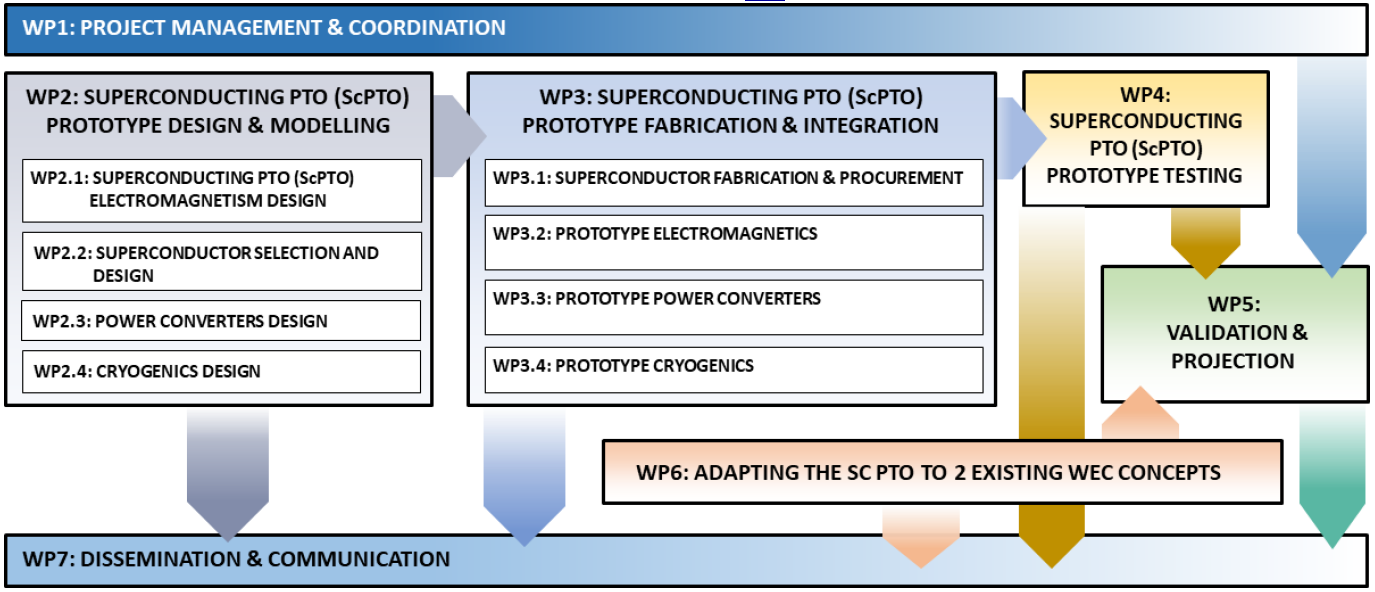
Work Package 2 was the centre of gravity of RP1, and it has been fully completed. The consortium built the Mares Model One (MMO) analytical code, then validated and refined its results through 2D and 3D Finite Element Method simulations in COMSOL Multiphysics and QuickField.
The outcome went beyond the plan. The finalised simulations, including dynamic electrical simulation of the power electronics, established that the prototype can safely reach a nominal force more than three times the laboratory-scale target set in the Description of the Action.
By the end of the period, the complete mechanical layout, the structural tolerances of the cryostat mandrel and the translator dimensions were frozen and verified, providing the exact blueprints needed to start manufacturing.
One machine, two superconducting pathways
MARES must validate two frontier materials at TRL 4: Machine H, using second-generation REBCO coated conductor tapes operating at 60–77 K, and Machine L, using multifilamentary MgB₂ wires operating at 12–25 K.
The original plan called for a single cryostat containing two fully wound stators sharing one translator. During the engineering phase the consortium shifted to a modular architecture: one unified structural validator, one passive steel translator, one external cryogenic Cold Box, and a stator cold mass engineered as a universal, plug-and-play receiver slot that accepts either coil module.
The scientific argument for the change is strong. Testing both materials inside the same physical validator subjects them to identical stroke velocities, displacements and force boundaries, allowing a genuinely direct comparison of AC coupling losses, critical current degradation and cryogenic stability. Running two temperature regimes simultaneously would have made it far harder to attribute thermal losses to either material, and would have raised total losses through double the current leads, more complex cryogen paths and a larger radiation screen.
The change also de-risks the programme. Under the original back-to-back scheme, if one machine underperformed, the other could not be tested across its full range. In the modular approach each machine is tested independently, with reaction force supplied by an external commercial actuator that provides a consistent reference across the whole measured range.
Introducing “Little Mares”
Alongside the modular shift, the consortium added an intermediate hardware step that was not in the original proposal: Little Mares, a dedicated one-phase validator.
Little Mares will serve as an early empirical testbench to confirm the manufacturing feasibility and structural binding of the superconducting coils, evaluate the thermal stability and vacuum insulation of the forced-flow helium circuit, and check how the ferromagnetic iron behaves at cryogenic temperatures. Establishing this hardware testing loop before full prototype integration means problems surface early, when they are cheap to fix.
Cryogenics
The cryogenic architecture is a closed-loop forced-flow helium gas system sized to stabilise the cold mass for either REBCO tapes or MgB₂ wires. A passive thermal radiation shield wrapped in Multi-Layer Insulation, an internal vacuum and optimised G-10CR structural supports together hold the parasitic heat load inside the budget set for the machine, and transient simulations confirm that the cold mass reaches nominal operating temperature from ambient well inside the project requirement.
Manufacturing has started
With WP2 closed, Work Package 3, led by ANTEC, is now under way. As of the end of RP1: manufacturing processes and drawings for the HTS double-pancake coils, mould clamping mechanisms and universal stator interfaces are complete and approved; the MgB₂ coil process is well advanced; iron stack manufacturing is defined with procurement ongoing; the linear reaction actuator has been purchased; cryostat detailed design is nearly finished with first supplier contacts made; and the power electronics specification is set, with procurement in progress.
In parallel, WP4 has begun early de-risking work on cryostat interfaces. Bellows solutions, PTFE and metallic, have been tested at CERN for vacuum leak tightness, cryogenic leak behaviour, dimensional tolerance and seal performance. Early results suggest PTFE bellows may not suit the MARES application, though further testing is needed before a definitive conclusion.
A rare-earth-free path
The societal case for MARES rests on European technological sovereignty. Conventional high-force direct-drive generators consume substantial volumes of critical rare earth materials such as neodymium and dysprosium, sourced from concentrated and volatile markets with significant local environmental cost.
By combining a laminated-steel reciprocating translator with superconducting stator coils, the MARES design removes permanent magnets, and with them neodymium and dysprosium, from the generator altogether. Quantifying the resulting reduction in critical raw material use against equivalent state-of-the-art wave energy converters is a defined objective of the project, and that assessment is scheduled in WP5. That message was carried to industrial and political stakeholders at the Transfiere Forum in Málaga and the Big Science Industry Forum in Madrid.
There is a second, subtler benefit. Superconductor performance improves in sudden jumps; REBCO critical current density recently stepped up by around 40%. In a conventional machine, capturing that gain means re-engineering everything from coil casing to cryostat. The modular MARES platform absorbs material changes through swappable stator inserts, adaptive helium mass flow between 60 K and 20 K, and software-adjustable monopulse control. Capital investment is protected against shifting material baselines and single-source supply chain failures.
Scientific output ahead of schedule
RP1 dissemination has run ahead of plan. Six papers have been published, five further abstracts submitted, and three conference talks delivered: two at EWTEC 2025 and one at ICSM 2025 in Turkey, in a session dedicated to large-scale superconductivity for waterborne and oceanic applications. With eleven papers active at the 18-month mark, the consortium expects to surpass the cumulative target of twelve publications set for the entire project.
The RSG concept and a new switching strategy for reducing AC losses were both introduced at EWTEC 2025. A paper on numerical methods for AC loss under moving magnetic matrices has been submitted to ASC 2026, and the cryogenic concept to ICEC/ICMC 2026. A paper on the optimisation procedure for low-loss MgB₂ wire is published.
MARES also contributed to postgraduate training at the INFIERI 2025 International Summer School in Pisa, organised under the CERN framework, including hands-on testing of an HTS coil in liquid nitrogen.
What comes next
The second reporting period is where MARES stops modelling and starts measuring. Little Mares will be built and tested, the full prototype assembled, and the first experimental datasets generated. That data will feed back into the MMO software and turn it from a theoretical tool into a validated instrument for dimensioning utility-scale machines.
MARES has received funding from the European Union’s Horizon Europe research and innovation programme under grant agreement No. 101172746. Follow the project on LinkedIn and X, and subscribe to the newsletter at maresproject.com.